

Your Blog - What's Working
Check Out The 10 Most Popular Posts And Learn From It
Posted by Charlie Recksieck
on 2024-11-21
You absolutely need to use your blog’s site statistics to tell you what people are responding to or clicking on. You need to see which articles perform best to understand what’s working and what isn’t. And to shape what you should be writing about next.
How You Can Find Your Stats
You HAVE to be doing something to track your website and see statistics about every page and user action. If you haven't set up analytics yet, we can help. You should be using tools like Google Analytics. If you need help with these, ping us.
Blog Platforms:
WordPress: Dashboard -> Stats (or "Site Kit / Jetpack" if installed)
Squarespace: Home -> Analytics
Wix: Dashboard -> Analytics & Reports
Blogger: Stats -> Pageviews / Posts
Squarespace: Home -> Analytics
Wix: Dashboard -> Analytics & Reports
Blogger: Stats -> Pageviews / Posts
Google Search Console:
This tells you how your blog performs in search; extremely helpful for SEO:
Total clicks + impressions (how many people saw your listing)
Average Google ranking
Exact search queries bring traffic
Click-through rate per post
Average Google ranking
Exact search queries bring traffic
Click-through rate per post
Where to look: Performance -> Pages
Then click a specific URL for query-level insight.
Social Media Analytics:
If some posts are shared a lot, you'll see them here.
Facebook / Instagram Insights
X/Twitter Analytics
Pinterest Analytics
LinkedIn Post Performance
X/Twitter Analytics
Pinterest Analytics
LinkedIn Post Performance
These can uncover viral topics you might not expect.
Google Analytics:
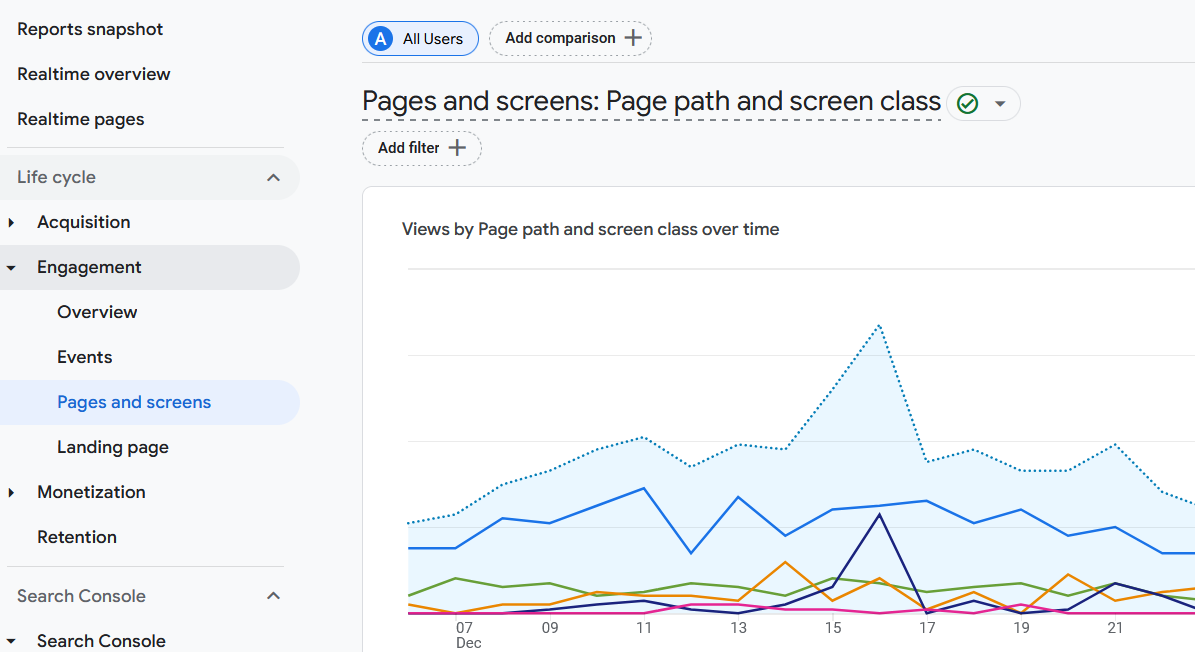
Where to look: Reports -> Engagement -> Pages and screens
Then search for any URL or filter by content group.
You can also set trackable goals for email signups, link clicks, and purchases.
Once you're collecting data, then you need to interpret it ...
What You Learn From Your Stats
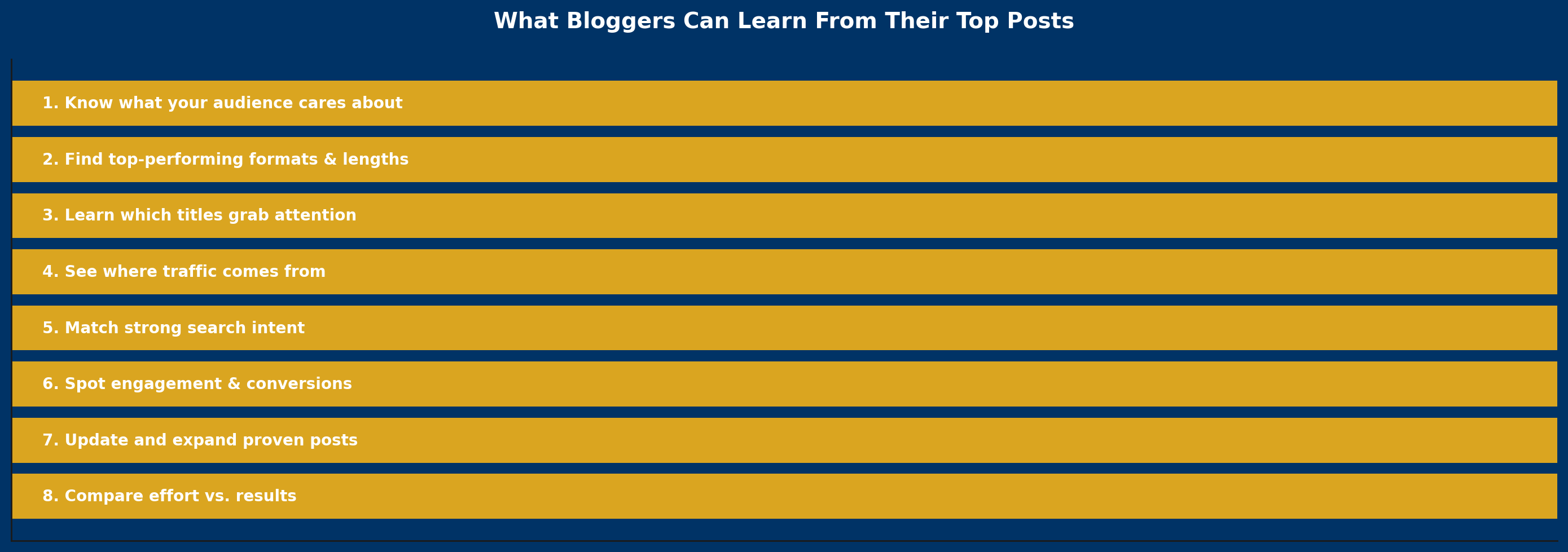
Your best posts reveal real-world reader interest - sometimes different from what you thought would perform. The whole point of the blog is to reach people, so listen when the statistic tell you what people are interested in.
Patterns in topics, keywords, or problem-solving styles help you double down on what works.
Formats - Does your audience love list posts? Deep tutorials? Tips? Opinion pieces? Looking at engagement metrics (time on page, scroll depth, clicks) shows what keeps people reading.
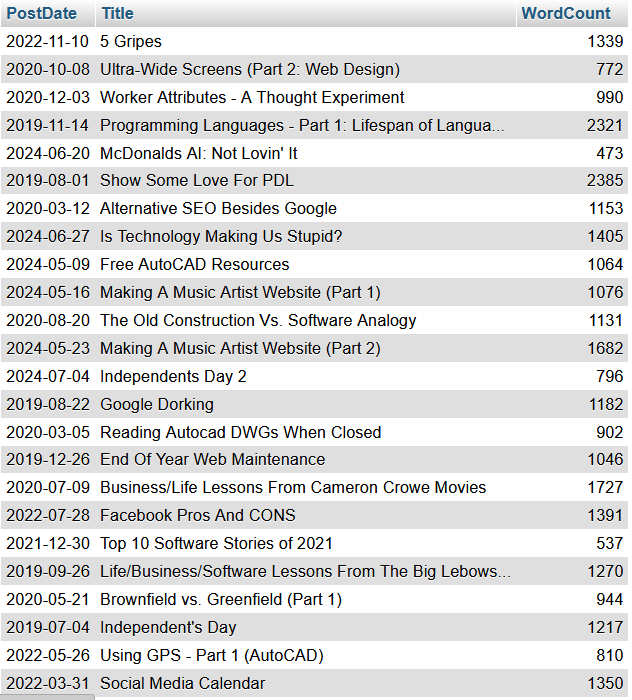
Length - Easy enough to check. I know blog posts here should be more like 500 words, but often I can't help myself from going over 1000 words. If you end up writing a solid article that’s too long, split it up into a Part 1 and Part 2.
Titles - Studying the titles of your most successful posts helps improve future headlines.
Where Traffic Is Coming From - Like with anything on the web, finding out where people are coming from helps your marketing. Find what's worked and double down on it.
Ongoing Traffic - If an old post is still doing well, it's an evergreen for you - return to it. Updating it or writing a Part 2 can give you great results.
Effort vs. Results - You’ll remember which posts took more time to do. Writing articles takes time, so you've got to be efficient with your workday. Judge the value of writing an article on the time spent AND success metrics together. Your #5 post that took a while is not nearly as valuable as your #6 post that you dashed off quickly.
In short, your analytics aren't just numbers - they're a map to: improved strategy, better use of your time, stronger audience connection, and better hitting your goals with the blog.
Maybe this goes without saying, but looking at your prior posts and which have been relatively for successful tells you what to write more of. If posts with Top 10 lists are killing it, then make sure to write some more of those.
Plannedscape Top 10
Here are our most popular articles in order:
1) 5 Gripes - Surprising performance for a cranky old man article.
2) Web Design Ultra-Wide Screens - Covered a topic we really haven't seen mentioned that much for web design.
3) Worker Attributes - Silly idea that's actually smart (and a little insulting to dumber workers)
4) Lifespan of Programming Languages - Researched compendium about various coding languages, took a lot of time.
5) McDonalds & A.I. - My quick take on basically a news item.
6) PDL & Pseudocode - A subject I'm passionate about. Also, an older article, so more time to accumulate hits.
7) Non-Google Search Engines - This one's a headscratcher; others must have written about this, too.
8) Is Technology Making Us Stupid - One I'm really proud of. Unusual topic, a little silly and took a long time.
9) Free AutoCAD Resources - My AutoCAD content is more niche and this is a helpful list.
10) Making A Music Artist Website - One that I've got experience with and perhaps good linkbacks from music sites.
2) Web Design Ultra-Wide Screens - Covered a topic we really haven't seen mentioned that much for web design.
3) Worker Attributes - Silly idea that's actually smart (and a little insulting to dumber workers)
4) Lifespan of Programming Languages - Researched compendium about various coding languages, took a lot of time.
5) McDonalds & A.I. - My quick take on basically a news item.
6) PDL & Pseudocode - A subject I'm passionate about. Also, an older article, so more time to accumulate hits.
7) Non-Google Search Engines - This one's a headscratcher; others must have written about this, too.
8) Is Technology Making Us Stupid - One I'm really proud of. Unusual topic, a little silly and took a long time.
9) Free AutoCAD Resources - My AutoCAD content is more niche and this is a helpful list.
10) Making A Music Artist Website - One that I've got experience with and perhaps good linkbacks from music sites.
What Do Our Stats Tell Us
A quick look at how many Top 10 appearances our blog's categories tells us this much off the top of the bat:
Web 3
Programming 2
General 2
Autocad 1
AI 1
Business 1
Security/IT 0
Marketing/Advertising 0
Social Media 0
Pop Culture 0
Programming 2
General 2
Autocad 1
AI 1
Business 1
Security/IT 0
Marketing/Advertising 0
Social Media 0
Pop Culture 0
That's only a 10-article sample size but I've looked further with other database queries. What's I've learned in general is that our content for programmers does better than I'd expected and my favorite type, the pop culture silliness, doesn't do as well.
Some of the longer articles have done better than I thought. Length of post doesn't seem to really impact the readership.
The Takeaway
Not looking at your web or blog stats is a totally unforced error. If you're serious about your job or your website or your writing, whatever your endeavor is, you've got to do at least a little homework.
It's also important for a blog - just as with any social media account or marketing effort - to have a goal. I mean a specific goal, not some vague idea about "success." Goals can be numbers of eyeballs, client leads, clicks, comments, shares, whatever.
Once you've got a goal you can use your statistics to judge if it's worth it, what strategies to double down on, and what tactics to abandon.
